
MELD Video Lens
View the walkthrough through the method.
When the real video is added, this module can connect the walkthrough to buyer lenses, product sections, and the session receipt.
Agentic Products / The CLEAR AI Method™
An AI workflow mapping kit for deciding where AI belongs before you automate the wrong thing.
Most businesses do not need more random AI prompts. They need a clear way to choose one workflow, decide what AI should handle, keep human judgment in the loop, and turn AI curiosity into responsible implementation planning. The CLEAR AI Method™ gives that decision a structure before automation begins.
Product Walkthrough
This is where a short founder-led product video belongs: Preston walking through why the kit exists, how to use it with the AI tools buyers already have, and what they should expect to produce before they automate anything.
When the real video is added, this module can connect the walkthrough to buyer lenses, product sections, and the session receipt.
The Buyer Problem
You may know AI can help the business, but the hard question is more specific: what workflow should use AI first, and how do you design it safely?
This kit gives you a structured way to inspect one process before budget, tooling, or developer time goes toward the wrong automation.
It helps you answer the practical AI implementation questions: where should AI assist, what should a human still review, what data is required, what could fail, and what is the first realistic step?

Prompt engineering, CLEAR AI, FOCUS AI, agentic prompting, and practical AI frameworks.

AI author, emerging technology leader, educator, speaker, and builder of applied AI systems.
Why This Method Exists
The CLEAR AI Method™ is not a generic AI package. It comes from Preston McCauley's published AI teaching and the systems he has built around those techniques: complex AI architecture, governance models, agentic workflows, automation layers, and adaptive orchestration.
That matters because buying this kit is not about collecting prompts. It is about using a tested AI thinking process to decide where AI belongs in a real business workflow before money, tooling, or team trust gets spent in the wrong place.
Author
Systems Builder
Implementation Lens
CLEAR AI Product Difference
Keeps the response structure stable across turns instead of letting the product drift.
Moves the work through human review gates, assumption checks, and refinement before output.
Gives buyers reusable ways to steer, compare, visualize, debug, and get help.
| Product Difference | CLEAR AI v6.8 | Typical Prompt Product |
|---|---|---|
| Real-time adaptive calibration Beginner-to-expert guidance is visible to the user as the session changes. | The Status Line shows live calibration so the buyer can see how the system is adapting. | Most prompt products stay static or make the user guess how the session is being handled. |
| Diamond Invariant A structural frame is maintained across the full response experience. | 17 anchor points keep output structure consistent across turns, even as the topic changes. | Most prompt products drift as the conversation changes or the user adds new context. |
| Dynamic capability self-query The system checks what tools and capabilities are available before it acts. | Boot-time detection lets CLEAR AI adjust to the available model, tools, and environment. | Many products assume a fixed tool setup and become less useful outside that environment. |
| Five-phase structured analysis with gates The method moves through a repeatable CLEAR loop instead of a loose prompt chain. | Review gates, assumption checks, and refinement points are built into the process. | Some products use multi-step prompting but do not expose gates or assumption tracking. |
| Cross-platform design The method is not locked to one AI vendor or one model family. | CLEAR AI is designed for GPT, Claude, Gemini, Copilot, and local or internal AI models. | Many prompt products are written around one model and lose value when moved elsewhere. |
| Simulate mode The product can demonstrate its own workflow before a buyer commits to a use case. | Built-in simulation creates an end-to-end demo path for sales, onboarding, and education. | Most products require the buyer to imagine the workflow or test it manually from scratch. |
| Thirteen-command vocabulary Users get practical commands for steering, comparing, visualizing, and debugging. | A three-tier footer teaches reusable commands like break it, visualize, compare, and help. | Most prompt products do not teach buyers how to control the system after the first answer. |
| Perspective-visible thinking The user can see which expert lens is being applied to the work. | CLEAR AI names the active perspective and can blend domain lenses as the session evolves. | Role prompts often stay fixed, even when the business problem needs a different lens. |
| Failure-Outward Analysis The method starts by finding where the work can fail before promising success. | Three failure surfaces are reviewed before the system moves toward the recommended output. | Most prompt products optimize for quick output before risk, constraints, and failure points. |
| Session receipt The buyer leaves with a shareable summary of what was mapped and decided. | Module 12 produces a reusable receipt that documents the session, decisions, and next steps. | Most prompt products end at an answer and do not create a durable implementation artifact. |
Starter Kit
Version one stays intentionally focused. It helps you map one business process, identify the AI fit, define human vs. AI responsibilities, review failure surfaces, and decide the first responsible implementation step.
Frame one real process before deciding where AI should assist, what should change, and what should stay human.
Check the practical conditions around data, tools, ownership, risk, and adoption before implementation starts.
Clarify what AI can draft, suggest, retrieve, or route, and where human review remains accountable.
Identify the places where an AI-assisted workflow can drift, misfire, expose risk, or lose trust.
See the method applied to a customer-support workflow so the mapping process is concrete, not theoretical.
Turn the map into a first build, pilot, review, or simplification decision instead of another AI idea list.
Product View
The product is more than a cover image. Each file has a job: capture the workflow, decide where AI belongs, keep human responsibility visible, inspect risk, and choose the next implementation step.
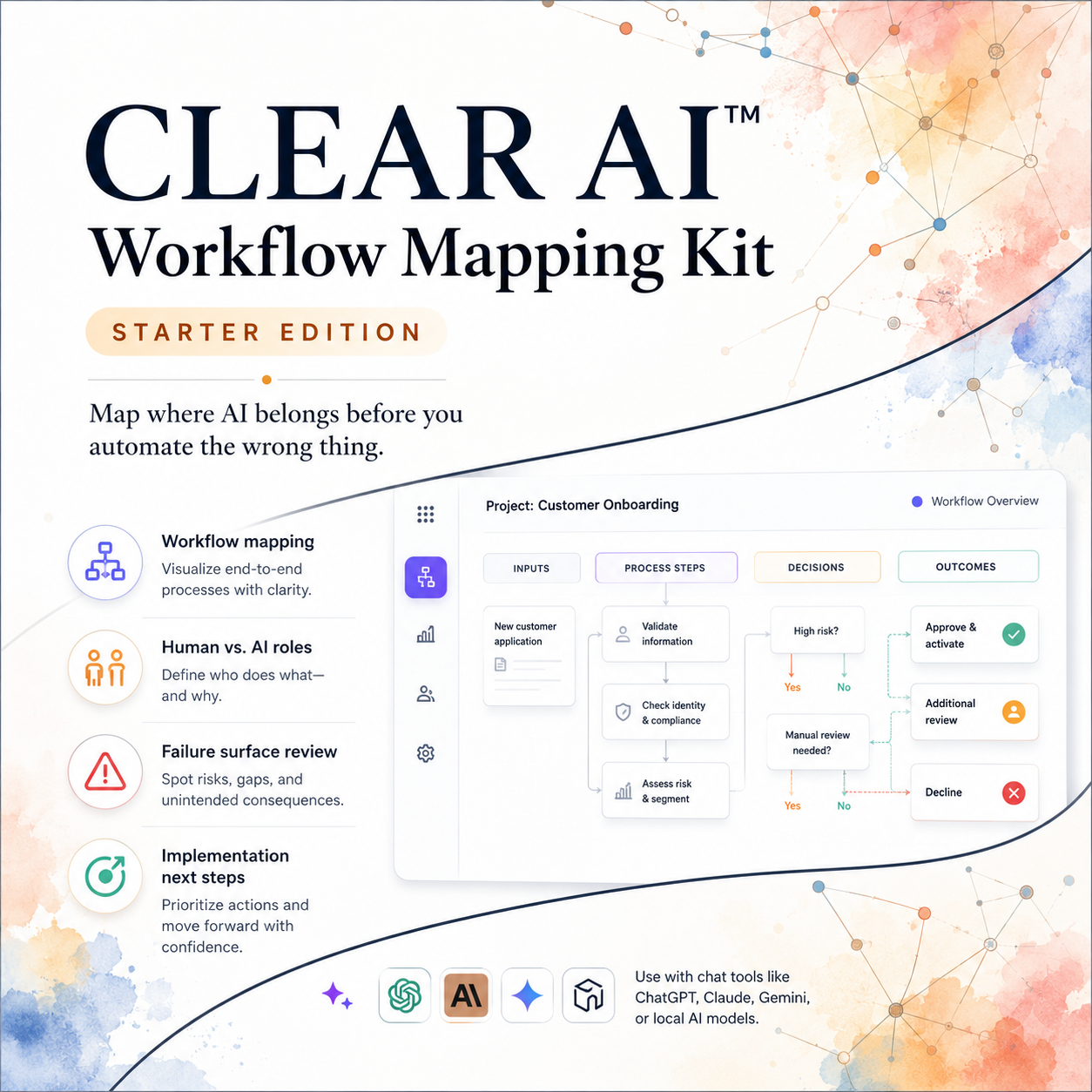
The kit is packaged as one focused digital product built around The CLEAR AI Method™ and one practical workflow decision.
How to Use the Kit
The Starter Edition works with ChatGPT, Claude, Gemini, Microsoft Copilot, Perplexity, local AI models, and internal company AI assistants. You do not need a custom app to map one workflow clearly. You need a practical method for deciding where AI belongs.
Start with a real process that has a beginning, middle, and end. Avoid vague goals like “use AI in our business.”
Capture the business goal, current steps, pain points, human judgment requirements, available data, and success metric.
Paste the skill and workbook into ChatGPT, Claude, Gemini, Copilot, Perplexity, a local model, or an internal AI assistant.
Check clarity, limits, examples, adaptation, and refinement before turning the workflow map into an implementation plan.
MELD Workflow Fit Check
This turns MELD into a practical buyer guide. Answer a few questions and the site creates a lightweight recommendation you can keep in the session receipt.
Use the Kit To
The kit is not a magic automation system, a 1,000-prompt bundle, or a replacement for technical, legal, or security review. It is a practical design tool for thinking clearly before AI implementation.
First Workflow Ideas
A good first AI workflow mapping exercise has a clear beginning, middle, and end. Start with assistance before full automation, and measure the workflow before scaling it.
What Good Output Looks Like
A strong result is specific to your workflow, realistic about your constraints, and clear about what AI should not decide. If the output is too generic, the kit gives you the prompts and review lens to tighten it.
Apply It With Preston
Book a CLEAR AI™ Workflow Review and Preston will help map one real workflow with you: where AI belongs, where human judgment stays responsible, what risk exists, and what the first implementation step should be.
A focused review for one workflow. The kit creates the entry point; the review turns it into a sharper implementation decision.
CLEAR AI™ Product Line
The workflow kit is the first product. The next step is a governance readiness kit for teams that need policy, review paths, and responsible AI usage before adoption spreads.
Guide AI through a structured workflow-mapping flow before trying to automate a business process. Identify where AI can assist, where humans remain accountable, what risks exist, and what the safest first step should be.
$49 View detailTurn prompts you use regularly into reusable workflow systems that guide AI step by step, ask for the right inputs, stop at human checkpoints, avoid invented details, and produce consistent output across ChatGPT, Claude, Gemini, Copilot, and local models.
$49 View detailGuide AI through a structured prioritization flow to compare multiple ideas by business value, effort, data readiness, risk, adoption friction, and time-to-impact.
Planned PlannedA structured evaluation system that acts as the trust layer between AI-generated research and human action. Examine the reasoning, evidence boundaries, and missing perspectives behind the polished AI output before you rely on it.
Pricing announced at launch PlannedFAQ
Quick answers for buyers deciding whether this kit fits their workflow, team, and AI implementation stage.
No. The kit is an AI workflow design tool. It helps you decide where AI belongs, where it does not, what humans still approve, and what risk has to be handled before automation.
Small business owners, founders, consultants, product leads, operations leaders, fractional CTO clients, and internal AI champions who need a practical starting point for AI implementation.
A mapped business workflow with AI assistance points, human responsibility points, data and tool needs, risk surfaces, and a practical first implementation step.
Yes. The Starter Edition is built for common AI chat tools including ChatGPT, Claude, Gemini, Microsoft Copilot, Perplexity, local AI models, and internal company AI assistants.
Start with a useful but lower-risk workflow such as customer support triage, sales lead qualification, meeting follow-up, internal reporting, ticket classification, research intake, or knowledge base cleanup.
Do not start with legal decisions, medical decisions, hiring or firing decisions, financial approvals, compliance determinations, or customer account changes without human review.
Book a CLEAR AI Workflow Review. Preston can help map one real workflow with you and turn the kit into a concrete implementation decision.