The Fiction of the Void
How a 70-year statistical illusion manufactured chaos out of low-dimensional projections—and why the future of AI depends on seeing the structure we mistook for noise.

For seventy years, machine learning and statistics have often treated the "curse of dimensionality" as a fundamental barrier—the observation that as variables multiply, space empties out, distance metrics collapse, and sample requirements explode exponentially. In this foundational essay, Preston McCauley argues that this curse is not a property of physical reality, but an artifact of an unconstrained Euclidean assumption: the belief that data lives as uniform dust scattered across an empty void. In physical, biological, and cognitive systems, nature defaults to rigid constraint manifolds. By inverting the classical view, high-dimensional space is revealed not as a curse, but as the precise feature that pushes entangled patterns apart and allows structure to separate. This essay is an argument—and an invitation to argue back: that much of what we call statistical chaos may be a property of our vantage point, not of the systems themselves.
"I call our world Flatland, not because we call it so, but to make its nature clearer to you."
— Edwin A. Abbott, Flatland (1884)
Four Shifts in Perspective
The core conceptual shifts that unlock high-dimensional problem spaces.
A meaningful fraction of what statistical models label as irreducible noise or stochastic chaos may simply be the friction of projection—distinct trajectories forced to appear to collide once unobserved depth is discarded.
The emptiness of high-dimensional ambient space is not a defect; it is nature's insulation. Physical and biological systems live on low-dimensional constraint surfaces where structured patterns remain cleanly separated.
What looks hopelessly tangled on a flat screen often falls cleanly apart the moment you stop flattening it. Clarity is a question of shape, not simply of gathering more data.
Systems are not static isolated points in arbitrary coordinate boxes. They are dynamic, responsive networks defined by their continuous relationships to the constraints around them.
The Sphere in Flatland: A Provocation
In Edwin A. Abbott’s classic 1884 novella Flatland, a society of two-dimensional shapes lives entirely on a flat plane. They have length and width, but absolutely no concept of depth. "Up" does not exist in their vocabulary. When a three-dimensional sphere visits their world, they cannot perceive a sphere. All they see is a mysterious circle that magically appears from nowhere, grows, shrinks, and vanishes as the sphere passes through their flat reality. To the Flatlanders, this is a terrifying, inexplicable miracle—a chaotic violation of the laws of nature. To the sphere, it is just an ordinary object moving through space.
We are not so different from those Flatlanders. When we encounter deeply complex, multi-variable problems in the modern world, we try to understand them using tools and mental models that can only capture a few dimensions at a time. And when our data behaves in bizarre, chaotic, or seemingly impossible ways, we tend to assume the system itself is broken, overwhelmingly noisy, or fundamentally "cursed."
But what if the universe isn't broken? What if we are just missing an axis?
I want to open a conversation, not close one. What follows is a provocation I've been circling for a long time, and I'm putting it in writing because I think it deserves to be argued with in the open: the Curse of Dimensionality—the seventy-year-old monster of statistics and machine learning—may not be a property of reality at all. It may simply be an artifact of our own Flatland perspective.
For 70 years, we've believed that problems with lots of variables are basically impossible to solve. I'm asking whether the problems were ever impossible—or whether we just set up the math in a way that guaranteed they'd look impossible.
I'm not claiming the classical mathematics is wrong. The arithmetic is mathematically sound. What I'm questioning is whether those theorems describe the structured world we actually live in, or whether they describe a hypothetical universe—an empty, uniform, unconstrained Euclidean void—that nature rarely inhabits. It is like calculating mathematically that it is difficult to find a specific book in an infinitely large, disorganized warehouse. The mathematical logic is valid! But our world has architecture and shelves. The equation describes an unstructured void, whereas nature organizes itself along continuous paths.
The 70-Year-Old Ghost: What the Curse Actually Claims
In 1957, the mathematician Richard Bellman coined the term "the curse of dimensionality" while working on optimal control processes. His observation was straightforward, rigorous, and terrifying to anyone who works with data: as the number of variables (dimensions) in a problem increases, the volume of the space grows exponentially.
The classical formulation rests on three mathematical cornerstones:
2.1 Combinatorial Explosion of Volume
A single dimension with 10 intervals requires 10 samples to cover. Two dimensions require 10² = 100. By 10 dimensions, you need 10 billion samples. By 100 dimensions, the required sample count exceeds the number of atoms in the observable universe.
2.2 The Emptiness of High-Dimensional Space
As dimension d grows, the volume of a hypercube concentrates entirely in its corners, while the volume of an inscribed hypersphere drops to zero relative to the enclosing box.
2.3 Distance Concentration and the Death of Proximity
Driven by the Law of Large Numbers, the variance of distances between randomly distributed points shrinks relative to their mean. In standard Euclidean L² space the distances concentrate so tightly that the ratio between the nearest and farthest neighbor approaches 1. When every point appears equidistant from every other, concepts like "similarity" and "cluster" lose geometric meaning.
These classical results are mathematically sound within their theoretical premises. But they model a uniform, unconstrained void—a hypothetical universe without the physical constraints that real systems obey.
The same holds for a fiber-optic cable on the Atlantic seabed: you do not need to survey the ocean's entire volume to locate it, because the cable occupies a single continuous, one-dimensional trajectory. A purely volume-based analysis treats the ocean's vastness as the obstacle; in structured reality, systems are rarely scattered at random—they run along constrained, continuous paths.
The Inversion: Why High Dimensions Are a Gift, Not a Curse
Here is the fundamental inversion: The curse of dimensionality only exists when you assume data is uniformly distributed across an unconstrained Euclidean void. But real physical, biological, and complex systems never inhabit the whole space. They live on low-dimensional constraint surfaces—manifolds—embedded within the high-dimensional ambient space.
Consider what happens when you flip your perspective:
- High dimensions provide insulation, not emptiness: The exponential volume means that unrelated phenomena have vast room to exist without interfering with one another. High-dimensional space is an insulator.
- Emptiness pushes noise away from signal: In 2D, random noise is forced to sit on top of your signal. In 100D, random perturbations scatter into the vast surrounding volume, leaving the structured constraint manifold cleanly isolated.
- Constraints define the true dimensionality: A human body has trillions of atoms (astronomical dimensions), but its movement is constrained by joints, muscles, and physics to a manifold of a few dozen degrees of freedom. You don't need to sample all of atomic space to model a walk.
- Room to separate: In a cramped, flattened view, everything looks tangled with everything else—there is nowhere for the pieces to go. Give them space, and distinct influences settle into distinct territory instead of piling onto the same coordinate.
The Shadow Puppet Fallacy: When Projection Creates "Noise"
Twenty-four centuries ago, Plato described prisoners chained in a cave, able to see only the wall in front of them. Behind them, unseen figures carry objects back and forth before a fire, and all the prisoners ever see are the shadows those objects throw onto the wall. To the prisoners, the shadows are not a projection of reality—they are reality.
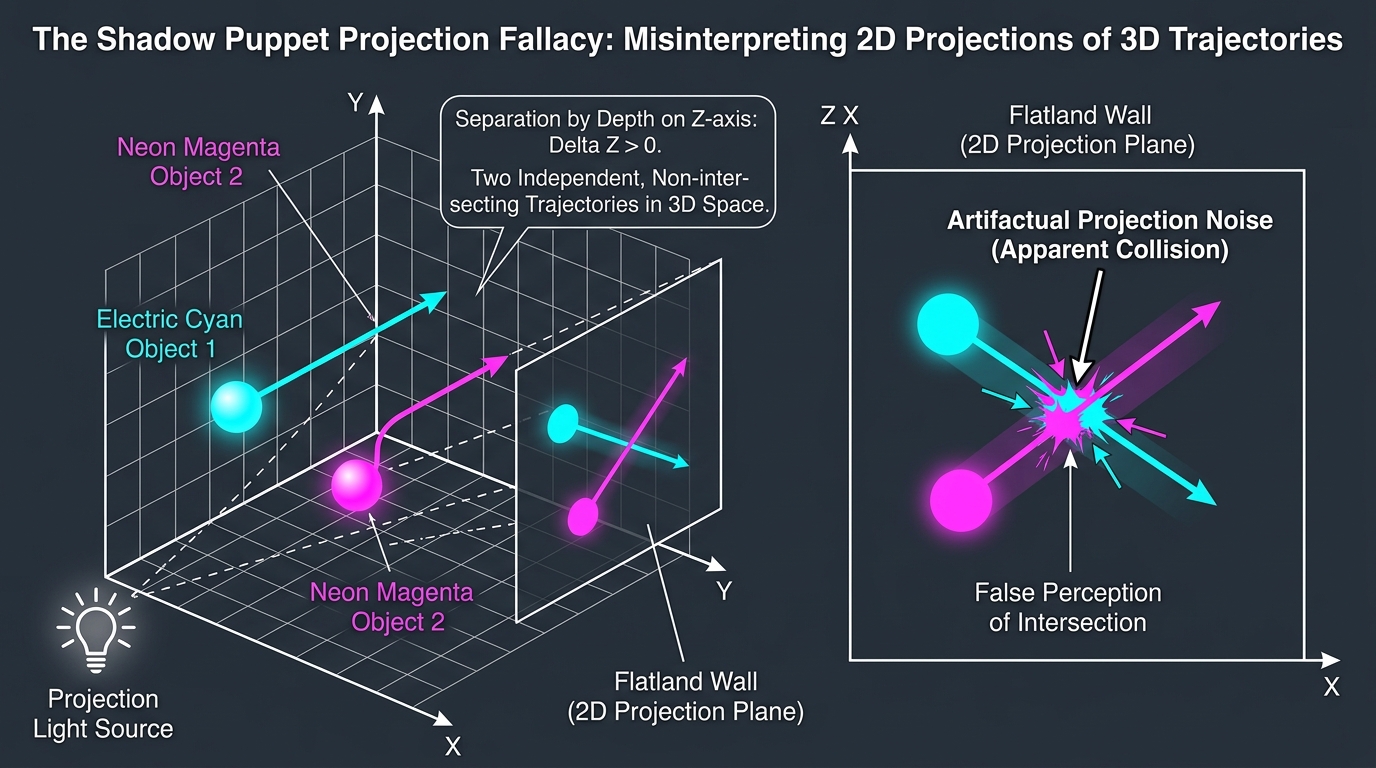
Now put two of those figures on the path behind the fire, one nearer the flame than the other. In the cave itself they are plainly apart; they never touch. But on the flat wall their shadows can slide across one another and merge into a single dark shape—an apparent collision that never happened. The depth that held them apart was discarded the instant the scene became a shadow.
A prisoner who studies only the wall will treat that merged shadow as a real and baffling event. Working from the flat view alone, they might catalogue the "inherent stochastic turbulence" of the shapes and build elaborate models to predict the odds of the next collision.
They might call it irreducible noise. But there is no noise. There is only a discarded dimension.
This is the Shadow Puppet Fallacy: when you project a high-dimensional system down to fewer dimensions, trajectories that never intersect are forced to cross. The overlap looks random, chaotic, or probabilistic—but the chaos was manufactured by the projection itself. We have too often been the prisoners, mistaking the wall for the world.
Real-World Examples: Where Flatland Thinking Breaks
This isn't just an abstract geometric puzzle. The shadow puppet fallacy causes real-world friction across science, medicine, finance, and engineering every single day.
5.1 Medicine and Diagnostics: The Symptom Projection Trap
Two patients present with identical symptoms: elevated blood pressure, fatigue, and headaches. In a 3-variable diagnostic space, they occupy the exact same point. The doctor prescribes the same medication. Patient A recovers; Patient B experiences acute organ toxicity.
Why? Because across genomics, proteomics, and cellular metabolism, Patient A had a biological pathway variant that Patient B lacked. The symptoms were identical flat shadow projections of two completely distinct multi-dimensional conditions.
5.2 Economics and Policy: The Aggregation Artifact
Economists track inflation using aggregate scalars like the Consumer Price Index (CPI). But CPI is a 1D shadow of an immense network of supply chains, energy costs, local labor markets, and freight bottlenecks.
When central banks adjust a single interest rate to move that 1D scalar, it creates contradictory reverberations across independent sub-economies—stalling housing while leaving other sectors untouched.
5.3 Complex Systems: The Convective Mystery
Two atmospheric profiles show nearly identical temperature and pressure readings. One produces an ordinary rain shower; the other spawns a violent tornadic storm. For decades, conventional science called this "chaotic sensitivity to initial conditions."
When you observe the system across full continuous flow vectors and thermodynamic couplings, the two air columns were never close to begin with. Their trajectories separated miles upstream in dimensional space.
When More Measurements Clarify Instead of Confuse
In classical statistics, adding variables is assumed to pile on uncertainty—more dimensions, more noise—unless you pay for them with exponentially more data. That is the core dogma of the curse.
But that dogma only holds in the void. In a structured world the opposite is true: the right measurements do not multiply your uncertainty—they close in on the answer. And you already trust a technology that works exactly this way. It is sitting in your pocket.
Consider GPS. Each satellite you add does not muddy the picture; it sharpens it:
- One satellite places you somewhere on the surface of a sphere—an infinity of possible positions.
- A second narrows that to the circle where two spheres intersect.
- A third cuts the circle down to just two points.
- A fourth eliminates the impossible one and fixes your exact position, in space and time, to within centimeters.
Each satellite is one more dimension of measurement—yet the fourth one does not curse the calculation or demand exponentially more data to find you. It does the opposite: it collapses an infinite space of possibilities into a single point on the map.
That is the whole pattern. Used well, the right measurements are not the fog—they are the laser that burns through it. High dimensionality was never what hid the signal; done right, it is what reveals it.
Untangling the Knot: A Topological Thought Experiment
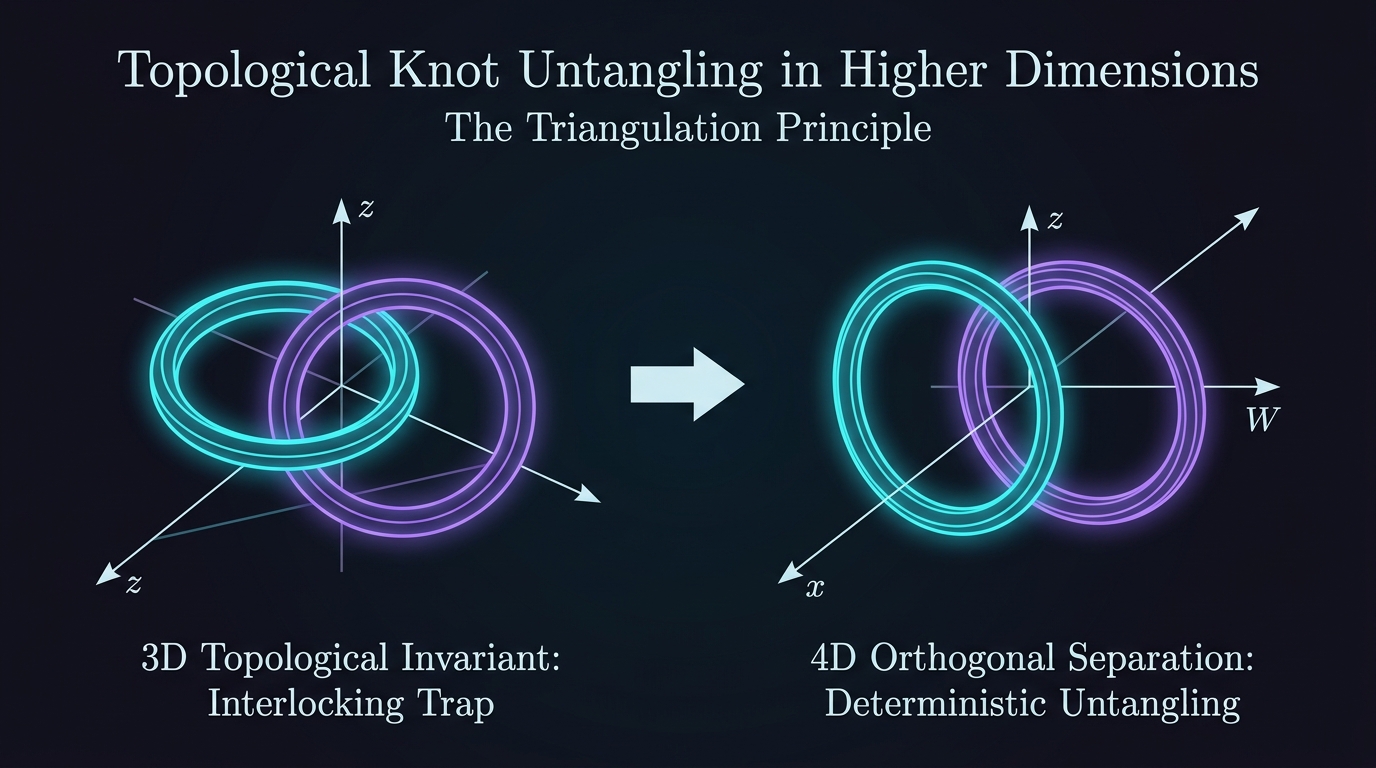
Take two closed rubber bands and interlink them in 3D space. Can you separate them without cutting either band? In a standard 3-manifold, topological knot invariants make it impossible. They are knotted.
Now introduce ambient isotopy within an manifold. Translate one segment along an additional spatial dimension—the W-axis—by a tiny fraction of a millimeter (), shift it sideways in the X-Y plane, and lower it back down. The algebraic intersection number of the curves resolves to zero: the bands slide past each other effortlessly, without ever touching or tearing.
What was an insoluble, rigid topological constraint in 3D became a trivial non-event in 4D.
How many problems in science, biology, and computation are we currently declaring "impossible" simply because we are trying to untangle a 4D knot inside a 3D box?
The Relational Shift: Beyond Isolated Boxes
To move beyond Flatland, we have to rethink how we model systems. In classical thinking, variables are treated as isolated, independent Cartesian axes forming an empty grid.
In reality, physical and biological entities are defined by their continuous relationships to physical anchors. An electron is not a static dot in a box; it is an active participant in an electromagnetic, weak, and gravitational manifold. A protein is not a random sequence of letters; it is a constrained physical origami folding along strict thermodynamic gradients.
When you stop treating dimensions as arbitrary coordinate axes and start treating them as relationships between things, the mathematics changes entirely. Dimensionality stops being a curse and becomes the ultimate language of systemic structure.
Conclusion: The Map Beyond Flatland
The curse of dimensionality has served as a seventy-year excuse for treating multi-variable systems as inherently chaotic, unpredictable, or unknowable. It convinced entire generations of scientists that the only way to handle complexity was to aggressively compress, project, and discard dimensions until the problem fit onto a flat 2D screen.
In doing so, we manufactured the very noise we were trying to escape.
High-dimensional space is not a statistical wasteland. It is nature's native architecture. Once you see that systems live on constraint manifolds, that structure sharpens what flatness blurs, and that most apparent randomness is the friction of projection, you can begin to meet complex problems in the native shape of reality—instead of in the flattened shadow we keep mistaking for it.
The door to higher dimensions has always been open. We just have to stop looking at the shadows.
Cite This Essay
Standard citation format for sharing, referencing, or academic citation.
@article{mccauley2026curseofdimensionalityflatlandtrap,
  title={The Fiction of the Void},
  author={McCauley, Preston},
  journal={Clear Sight Designs — From The Deep Research Lab},
  volume={Essay Note 2026.01},
  year={2026},
  url={https://clearsightdesigns.com/research-and-innovation/curse-of-dimensionality-flatland-trap}
}