
The Black Box Has Moved
AI agents aren't coming to your business. They're already there.
Maybe it started small—a tool that summarizes meetings, an assistant that drafts responses, a system that routes support tickets. But increasingly, AI in your organization isn't just answering questions. It's researching, writing code, retrieving data, calling tools, preparing decisions, and passing its outputs into other systems that keep working with them.
That shift raises a question most businesses haven't stopped to ask: can you actually inspect what you're trusting as that work moves through your systems?
Because once AI starts acting across tools, permissions, data sources, and handoffs, the model is no longer the only black box. Your workflow becomes part of the black box too.
This is exactly where most AI governance falls short today.
Think about how governance probably works in your organization right now. It surrounds the AI: a policy document, an approval committee, a responsible-use standard, a final review before deployment. Those controls matter. But they were built for a world where AI produced an answer and then politely waited for a human to decide what happened next.
Agentic AI changes that structure. An answer becomes an input. That input becomes a recommendation. That recommendation triggers another agent, calls a tool, updates a record, or influences a decision—before anyone on your team sees the full chain that produced it.
In that environment, governance can't stay outside the workflow. It has to operate inside the AI loop.
When your team first experienced generative AI, it was probably through a chat interface. Someone typed a prompt, the AI generated an answer, and a human evaluated it. Was it accurate? Useful? Biased? Did it make something up?
Those questions still matter. But an agentic system adds a whole new layer of complexity. The system may pull information from several sources, transform it, call external tools, inherit permissions, make assumptions along the way, hand work to another agent, and continue through multiple stages before you ever see a result.
Here's the risk that creates for your business: a polished answer can hide a degraded process underneath it.
The original intent may have weakened during a handoff. A limitation may have been dropped. Weak evidence may have been compressed into a confident conclusion. An agent may have acted with more authority than it was given. A downstream system may treat an unreviewed recommendation as an approved decision.
The final output looks completely reasonable—while the process that created it quietly moved outside its intended boundaries.
That's why inspecting the answer is no longer enough. Your business needs to be able to inspect the path that produced it.
Output Trust Is Not Process Trust
Most AI evaluation today focuses on what the CLEAR AI Method calls output trust: is the final result accurate, grounded, relevant, complete, and useful? Necessary questions, every one.
But agentic systems require a second layer—process trust—and this is the idea worth taking back to your team.
Process trust asks whether the result came from a governed path. Was the original intent clear enough to support action? Were the system's limits enforced? What evidence was used, and how reliable was it? Which assumptions crept in? Was uncertainty preserved or flattened? What authority did the agent actually have? Was a human supposed to review this before it moved forward?
Here's the uncomfortable truth from the AgentCon stage: an AI output can be correct even when the process behind it is unsafe. It can also be wrong while looking highly reasoned, polished, and confident.
Fluency is not proof of governance. Confidence is not proof of competence. And a citation is not proof that the cited source actually supports the conclusion.
The strongest AI systems—the ones your business can defend to a customer, a regulator, or your own board—need both forms of trust. They evaluate the quality of what was produced and the integrity of how it was produced.
The Most Dangerous Moment Is Not the Answer
The most obvious AI failure is a wrong answer. Everyone has learned to watch for that.
But in a multi-step workflow, the bigger danger for your business is often what happens after the answer is generated.
The agent finishes its task. The output moves forward. The next agent receives it. The workflow keeps going—simply because another step exists.
But the assumptions behind the output don't travel with it. The uncertainty disappears. The original boundaries fade. Authority starts to feel implied just because the system kept moving.
This pattern has a name in the CLEAR Governance framework: ungoverned continuation. A workflow advances because there is a next step—not because the system has earned the right to take it.
Why should that concern you? Because agentic failures rarely stay isolated. They propagate through your operations:
- A weak research finding becomes the foundation for a strategy recommendation.
- A flawed code analysis triggers an automated fix.
- An incomplete customer record shapes a support decision.
- An AI-generated legal draft gets treated as reviewed when it was only prepared.
- A risk score flows into an operational system without the conditions that should have limited its use.
The first agent doesn't have to make a dramatic mistake for your system to fail. It only has to pass forward something the next stage trusts more than it should.
Orchestration Is Not Governance
Modern agent frameworks are genuinely impressive at orchestration. They route work, select tools, call APIs, manage memory, coordinate agents, retry failures, and determine what happens next.
But orchestration and governance solve different problems—and confusing the two is one of the most common architectural mistakes businesses make when adopting agents.
Orchestration asks: What happens next?
Governance asks: Should it happen next? Under what authority? With what evidence? At what confidence? Within which constraints? Does this step require human review? What needs to be preserved for the audit trail?
Orchestration moves work. Governance determines whether that movement is justified.
A workflow can be technically well-orchestrated while remaining fundamentally ungoverned. Connecting more agents doesn't automatically make your system more intelligent, reliable, or safe. Sometimes it only lets weak context, false confidence, and misunderstood authority travel farther and faster through your business.
CLEAR AI as Runtime Governance
The CLEAR AI Method was originally created to help people frame, guide, and collaborate with generative AI. What's become clear through hands-on work building agentic systems is that the same structure matters even more when AI systems begin guiding other AI systems.
In a governed workflow, CLEAR can't live only in the initial prompt or the project kickoff. It becomes a set of runtime questions your system asks continuously. Here's what each one does for your business:
- Clarity: Is the objective specific enough for the system to act without inventing missing intent? Vague intent should never silently become machine-generated certainty.
- Limits: What is allowed? What is prohibited? What requires explicit approval? What information, tools, or actions remain outside the agent's authority?
- Examples and Evidence: What supports this step, and how strong is that support? Was the evidence directly observed, inferred, generated, retrieved, or inherited from another agent?
- Adaptation: What level of autonomy has the system earned under current conditions? Should it assist, recommend, draft, act with review, or stop?
- Reflection: Is the result safe, complete, and governed enough to move downstream? What remains unresolved? What could cause harm if the next stage over-trusts this result?
These aren't abstract principles for a governance slide. They become operational controls inside your workflow. Clarity prevents action on vague intent. Limits constrain authority. Evidence gives confidence a measurable basis. Adaptation determines how much freedom the system receives. Reflection decides whether the work continues, returns for clarification, requires human review, or stops.
CLEAR Governance doesn't just evaluate an agent after it finishes. It shapes the conditions under which the agent is allowed to operate at all.
Governance Must Travel With the Work
In a typical agentic workflow, Agent A completes a task and sends the result to Agent B. Agent B treats that result as context and starts the next task. Simple enough.
The problem: the output rarely carries the trust state behind it. It doesn't explain what was assumed. It doesn't flag which evidence was weak. It doesn't preserve the original limitations. It doesn't say whether the task was fully completed—or that human approval is still required.
The next agent receives the conclusion without the conditions under which that conclusion should be trusted.
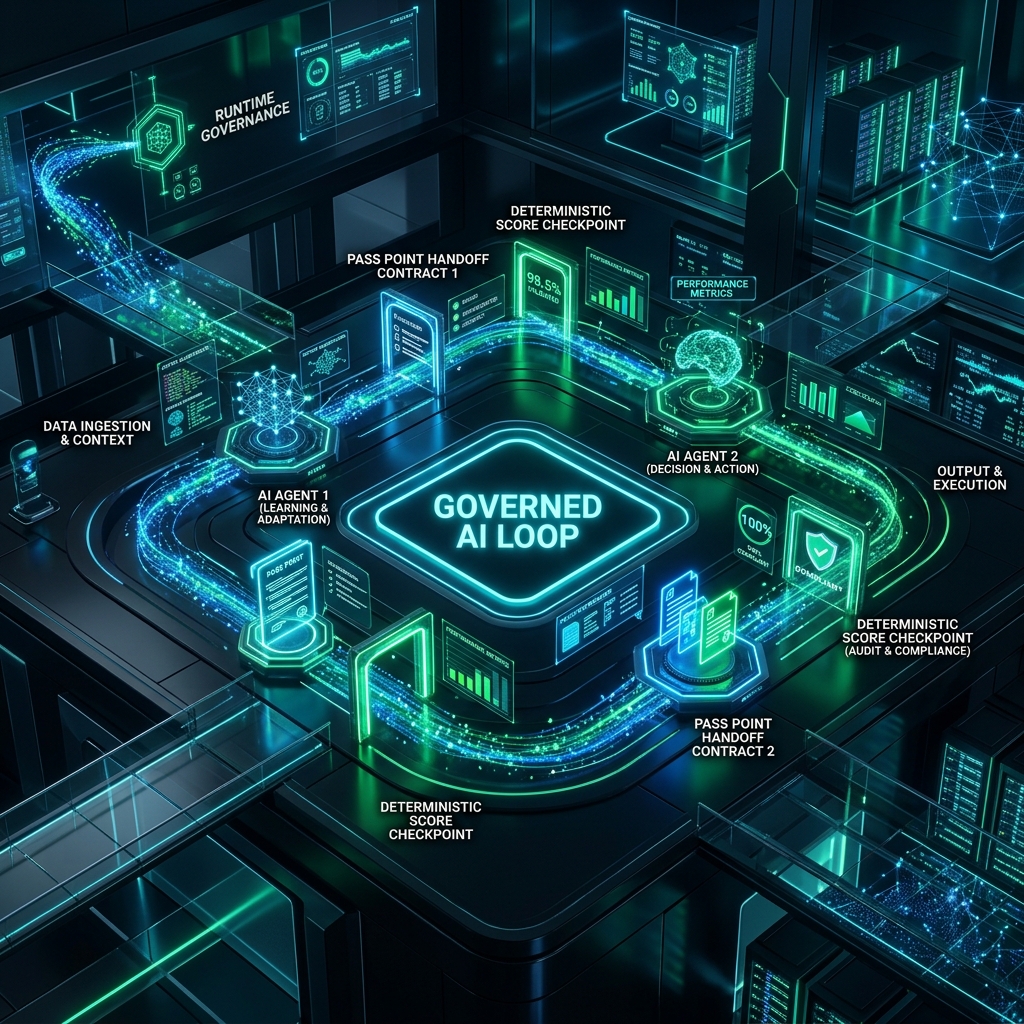
A governed workflow passes more than content. It passes process state. Within CLEAR Governance, this happens through a Pass Point—a governed handoff contract attached to the work as it moves through your system.
A Pass Point records:
- what was completed;
- what was assumed;
- which evidence was used;
- which limits remain active;
- what confidence was earned;
- what actions are permitted;
- what actions remain blocked;
- what risks are still present;
- and whether human approval is required.
Think of it as a receipt for the handoff. The next agent doesn't just receive an answer—it receives explicit information about what it may believe, what it may do, and what still needs validation.
This turns governance into a tangible state that moves with the work, rather than a principle everyone hopes the system remembers.
Did Governance Survive the Handoff?
Passing governance state forward is necessary—but not sufficient. Your system also needs to know whether that state survived the handoff.
Agentic systems often degrade at their boundaries. An agent may preserve the task while weakening the original intent. It may strengthen the evidence while quietly relaxing a limit. It may produce a more confident recommendation while reflecting less. It may introduce assumptions without recording them. It may keep the correct output format while fundamentally changing what the work means.
This is governance drift: the measurable change in trust state before and after an agent does its work.
Did clarity improve or decline? Were the limits preserved? Did evidence get stronger? Was uncertainty compressed? Did the agent expand its own authority? Did the output become more actionable without becoming more trustworthy?
Here's the distinction that matters for your operations: traditional logging tells you what happened. Tracing shows you where the workflow went. Governance drift tells you what became less trustworthy along the way.
A workflow can look technically successful while its trust structure quietly deteriorates. But once drift becomes measurable, your system can respond—reduce autonomy, request clarification, route the work to a human, return to a previous stage, or block the workflow entirely.
Governance stops being documentation. It becomes an active control over what your system is permitted to do next.
The CLEAR Governance Loop
Here's how governance inside the AI loop actually operates, in five recurring moves:
- 1. Receive: Each stage receives the prior governed state—the known intent, evidence, limits, assumptions, risk, confidence, and approval requirements. No agent starts from a clean slate when the work carries unresolved conditions.
- 2. Execute: The agent performs its task inside those boundaries. Being asked to complete a step doesn't grant unlimited interpretive freedom.
- 3. Score: The result is evaluated—and the AI should never be the sole authority scoring and approving its own reasoning. Wherever possible, thresholds, confidence calculations, and state transitions run through deterministic computation.
- 4. Create the Pass Point: The system records what happened: what changed, what was learned, what remains uncertain, which limits survived, and what the next stage is allowed to do.
- 5. Route: The governance state determines what happens next. The work may continue, require clarification, be prepared as a draft for approval, be reduced to a recommendation, or be blocked.
Then the loop begins again at the next handoff.
Governance isn't a scorecard bolted onto the end of a pipeline. It's the mechanism that drives the pipeline. Every handoff becomes a decision point, and every decision point asks whether the system has earned the next step.
Autonomy Is Routed, Not Assumed
Many AI systems treat autonomy as a light switch. The agent is autonomous or it isn't. It can call the tool or it can't.
But meaningful work in your business is rarely that binary. Think about how you develop trust in a new employee. You might trust them to gather information, prepare a recommendation, and draft a response—while still requiring approval before they commit budget or communicate publicly. Their authority grows with context, experience, evidence, and risk.
AI autonomy in your business should work the same way. A governed system routes autonomy across levels:
- Stop — The evidence or clarity is too weak to continue.
- Clarify — The system must ask for missing information before acting.
- Assist — The AI supports the work but can't make or frame the final decision.
- Draft for Approval — The system prepares the work; a human authorizes its use.
- Recommend — The AI proposes an action without executing it.
- Act With Review — The system acts, but the result gets inspected.
- Broader Autonomy — The workflow proceeds independently within a clearly defined, previously validated boundary.
The level is never determined by how impressive the model appears. It's determined by the current governance state. How clear is the intent? How strong is the evidence? What's the downstream risk? Have the limits survived? Has the system handled this type of decision reliably before?
Notice that people don't disappear from this picture. Your team becomes part of a deliberately routed authority structure—which is far more useful than placing a human inside every loop. Blanket review creates fatigue, superficial approvals, and the illusion of oversight. Human involvement should appear exactly where ambiguity, risk, authority, or consequence requires it.
The goal isn't maximum autonomy. It's appropriate autonomy.
Your People Must Remain in the Experience
Everyone talks about keeping a human "in the loop." But as AI systems grow more complex, that phrase becomes too simplistic. Which loop? At what moment? Reviewing what? With what context?
This is where decades of UX thinking meet AI architecture: an approval button is not meaningful oversight if the person clicking it can't see the assumptions, evidence, limitations, and trust state behind the result. Your people must be part of the experience of authority—not inserted at the end of the workflow as a ceremonial checkpoint.
That means your systems should present what a person needs to make a real judgment. What does the AI know? What doesn't it know? What changed during the workflow? Which risks remain active? Why is this level of autonomy being requested? What happens if the decision is wrong?
Human governance should never become a rubber stamp for machine-generated confidence. It should remain the layer that interprets meaning, consequence, context, and accountability when computation alone isn't enough.
Separate Reasoning, Scoring, Governance, and Execution
One of the most dangerous agentic architectures a business can run is one in which the same model reasons, scores its own work, authorizes its own next action, and then executes it.
That's not governance. That's generated confidence.
A stronger architecture separates responsibilities. The language model reasons. Computation scores measurable conditions. Governance routes authority. Agents execute within the resulting boundaries. Pass Points preserve state across the transitions. Your people retain authority where judgment, consequence, or unresolved ambiguity requires it.
This separation doesn't eliminate uncertainty—it makes uncertainty visible. It prevents the model's confidence from automatically becoming permission. The model may argue its conclusion is strong. The governance layer independently determines what that strength actually permits.
The Trace Becomes Part of the Product
In high-stakes AI systems, the final answer shouldn't be the only deliverable. Your system should also produce durable traces showing how that answer was created and governed:
- The original intent state;
- Evidence records;
- Source lineage;
- Pass Points;
- Before-and-after drift measurements;
- Risk assessments;
- Autonomy decisions;
- Blocked actions;
- Human approvals;
- and tamper-evident seals.
This produces something more valuable than a polished output. It produces governed proof.
A regulator, auditor, executive, customer, or internal reviewer can examine the process without having to blindly trust the system that performed it.
The trace isn't administrative debris. It's part of the product. For regulated businesses, it may be the most valuable part.
The Model Is Replaceable—Your Governance Shouldn't Be
AI models will keep changing. Your business will swap one for another as capabilities improve, prices shift, and new architectures emerge.
Governance can't be rebuilt every time the reasoning layer changes. The model should be replaceable. The governance structure should remain.
Intent definitions, limits, evidence standards, scoring logic, autonomy thresholds, handoff contracts, approval requirements, and audit traces should exist independently of whichever model happens to be running inside the system.
That's how you build durable AI architecture rather than a temporary demonstration tied to a particular model release. The reasoning layer may evolve every quarter. Your trust structure can't disappear with it.
Start With One Handoff
Before this starts to feel like re-architecting everything at once—it isn't. Here's the practical starting point for any business:
Govern one consequential handoff.
Find a place where an AI-generated output becomes someone—or something—else's input:
- research moving into a strategy decision;
- code analysis moving into remediation;
- customer data moving into a support action;
- a financial assessment moving into an approval process;
- an AI-generated summary moving into an executive report;
- a recommendation moving into an automated tool.
At that handoff, ask: What was the original intent? What evidence supports the output? Which assumptions were introduced? What limits remain active? What risk travels downstream? What autonomy has been earned? Does a human need to approve the next step?
Then capture that state. Measure whether it survives the crossing. Route the next action from the state—not simply because another workflow node exists.
That single change starts shifting governance from policy into architecture. And once your team experiences it at one handoff, you'll start spotting ungoverned continuations everywhere in your systems.
Govern the Process Before You Trust the Output
As AI moves from answering to acting, your business needs to expand what it means by trust. It's no longer enough to ask whether the final answer looks correct. You need to know whether the system understood the intent, stayed within its limits, used legitimate evidence, preserved uncertainty, earned its autonomy, and carried its governance state forward. You need to see where trust strengthened, where it degraded, and why the workflow was allowed to continue.
Orchestration says what happens next. Governance says whether it should happen next.
The businesses that understand this distinction won't just build more capable agents. They'll build AI systems whose actions can be inspected, constrained, defended, and trusted—by their teams, their customers, and their regulators.
Because trust should never be inferred from fluency. It must be earned. It must be measured. It must be preserved. And it must be governed throughout the AI loop.
I'll keep refining this work—the drift measurements, the Pass Point contracts, the autonomy routing—and I'll keep you updated as these techniques evolve. As always, happy to answer questions.
Always strive to understand, use, and stay ahead of technology.
About Preston McCauley & Clear Sight Designs
Preston McCauley is the founder of Clear Sight Designs and the creator of the CLEAR AI Method. With more than 25 years of experience across AI, product strategy, user experience, and emerging technology, he helps organizations move beyond isolated AI experimentation toward governed, production-ready systems.
His work focuses on the intersection of human intent, AI architecture, trust, evidence, authority, and experience—helping teams design AI workflows that don't merely produce work, but earn the right to move that work forward.
Everything in this article is work Clear Sight Designs does hands-on with client teams:
- Map your agentic workflows and identify the consequential handoffs where trust breaks down
- Design CLEAR Governance into your architecture—Pass Points, drift measurement, and autonomy routing built for your specific operations
- Prioritize AI use cases based on where governed intelligence creates measurable advantage, not where AI looks impressive
- Design human oversight that works—review placed where judgment matters, not rubber stamps at the end of every pipeline
- Evaluate production readiness so you know whether an AI initiative should advance, revise, pause, or stop before it becomes technical debt
The goal is never more AI for the sake of AI. It's systems your business can understand, measure, trust, and defend in the real world.
If you're wondering whether your AI workflows would survive this kind of inspection, request an Executive AI Architecture Briefing today. That conversation is exactly where the journey begins.